Friday, March 6, 2009

New York Dogfighting Laws

I hear that New York's laws on dogfighting are not very strong, and that New York is a center of organized dogfighting operations. Is that true?

No data supports such internet rumors. To address this concern, DFNY published the following press release.

Dog Federation of New York Sets Record Straight on
New York’s Dog and Animal Fighting Statutes


Group Expresses Concern that Inaccurate Information May Encourage Mistrust and Fear

March 5, 2009 – New York, NY -- Responding to irresponsibly-worded statements circulating on the internet regarding New York’s dog and animal fighting statutes, members of the Dog Federation of New York (DFNY) today provided the facts for worried pet lovers. Contrary to recent media coverage, New York’s anti-dogfighting statutes are among the most comprehensive in the nation.


"Only a person unfamiliar with our laws and how they function would describe them as ‘weak’," commented Mahlon Goer, spokesperson. “Under state law, a number of felony charges are available to prosecutors in dog-fighting cases. Our statutes and penalties are in line with, and in some cases exceed, those of neighboring states.”

“We were disappointed to see poorly-considered and speculative comments circulating on the web. Bad information only deepens misunderstanding, and encourages heightened levels of mistrust and fear of both dogs and dog owners. New Yorkers deserve public policy based on fact, not fear.”

The abhorrent crimes of organized dog and animal-fighting are serious offenses in New York, and DFNY hastened to correct any mistaken impressions that these crimes are common.

The New York-based ASPCA enforces animal cruelty laws, including anti-dogfighting statutes, in the City of New York. The ASPCA cautions that dogfighting exists all over the United States, but that it is not prevalent in New York City.

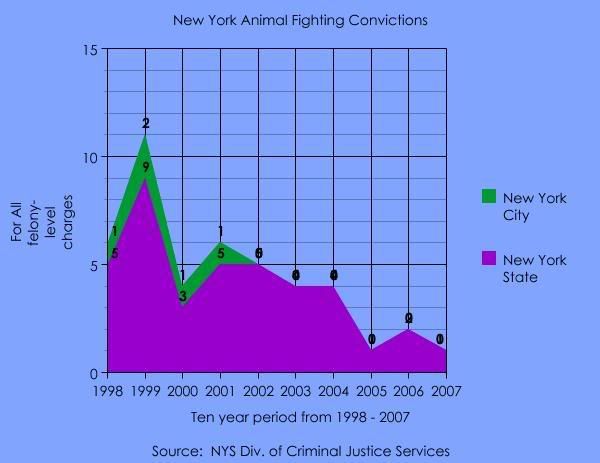
Information made available by the New York State Department of Criminal Justice indicates that for the last ten years, the number of convictions per year on animal-fighting charges in New York City typically hovers in the very low single digits. For several years out of the last ten, no convictions on animal-fighting charges were recorded for New York City. Statistics for New York State follow a similar pattern.

“Dogfighting is a heinous crime with serious consequences. We want to make sure that New York’s caring dog owners and pet lovers, and our public officials, have the facts before them,” said Ms. Goer. DFNY offers its resources and assistance to the public and community leaders to help educate the public on New York’s dog and animal fighting statutes and related issues. The group’s website offers information on these topics.

About the Dog Federation of New York:

The Dog Federation of New York is a statewide coalition of dog clubs, organizations and individual dog owners that serves the public interest by educating citizens and public officials on dog safety and responsible dog ownership. DFNY advocates for strong, and humane dog-related legislation and is committed to working with municipalities across the state to implement preventative dog safety education.


Read New York State's statutes on animal fighting.

Visit the Dog Federation of New York on the web.

Wednesday, October 15, 2008

Access to public space


What barriers to reasonable access to public spaces exist for New York dog owners?

Communities everywhere strive to balance the needs of both dog owners and non-dog owners with respect to use of public facilities and parks. New York State law protects the interests of law-abiding dog owners in several ways:

Only New York State may issue dog licenses, and municipalities may charge additional fees only to cover reasonable costs incurred in providing special services or amenities to the public.

Additionally, a long tradition of reciprocity between municipalities exists in New York. Non-residents should not be charged unreasonable extra fees for the use of public facilities.

The Dog Federation of New York vigorously supports the efforts of dog owners in New Rochelle (Westchester County) in their complaint against the City of New Rochelle and its unacceptable ordinance which severely restricts access to a public park there.

Recent press release follows below.

Westchester Dog Owners Win Appeals Court Decision

Dog Federation Of New York celebrates decision allowing challenge to
unlawful, discriminatory public policies targeting law-abiding dog owners


New York, NY – October 15, 2008 - The Dog Federation of New York (DFNY), appearing as amicus curiae in the case of During et. al v. The City of New Rochelle, applauds a decision from the New York Supreme Court Appellate Division, Second Department, reversing a lower court dismissal of the case. During oral argument on September 15, the Presiding Judge advised the City of New Rochelle to try to settle with local dog owners. The case is remitted to the Supreme Court, Westchester County for further proceedings.

The New Rochelle dog owners seek nullification of the city’s unprecedented, illegal, and punitive local ordinance, which unfairly requires them to obtain extra photo identifications and licenses, and pay special additional fees, simply to walk a dog in a public park. Dog walkers with leashed dogs in Ward Acres Park in New Rochelle are subject to a disturbing stop-and-search policy in which police officers are instructed to stop people walking their dogs and demand to see a special “Ward Acres Dog Permit” photo identification. Persons unable to produce the special licenses are asked to leave the park and, under the terms of the Ordinance, they are potentially subject to fines and/or imprisonment.

"As a statewide coalition of law-abiding dog owners, we are deeply concerned when a municipality illegally targets residents and tax-payers whose only ‘crime’ is walking a dog in a public place," stated DFNY spokesperson Mahlon Goer. “New Rochelle residents and non-residents alike are not second class citizens, and state law protects them from unwarranted searches, special license requirements, extra taxes, and other infringements of their civil liberties.”

"Ward Acres was the last park in New Rochelle open to people who want to walk their dogs, and now the City Council seems bent on forcing them out of it. Close to half of all households in New York include at least one dog, and we were surprised and dismayed to see that a better accommodation could not be worked out,” Goer continued. “Our goal is to promote dog-friendly and dog-safe communities for all New Yorkers. We are confident that better solutions are available.”

Paul, Weiss, Rifkind, Wharton & Garrison LLP in New York City represented the Dog Federation of New York in the appeal. The case was originally filed on April 16, 2007, as Dennis C. During, Michael S. Friscia and Marci Malone v. The City of New Rochelle in New York Supreme Court, Westchester County, Hon. W. D. Donovan presiding, Index No. 6561/07.

For further information on the amicus brief, please contact the Dog Federation of New York. A copy of the appeals court decision is available via this link.

To learn more about Ward Acres, the Westchester dog-owning community, visit
www.WeLoveWardAcres.net.

About the Dog Federation of New York:
The Dog Federation of New York is a statewide coalition of dog clubs, organizations and individual dog owners that serves the public interest by educating citizens and public officials on dog safety and responsible dog ownership. DFNY advocates for strong, and humane dog-related legislation and is committed to working with municipalities across the state.

Visit us on the web at www.DogFederationofNewYork.org

###

Saturday, September 6, 2008

Mandatory Spay-Neuter (castration) laws in New York


New York City law differs significantly with New York State on this subject.

Background: Law on dogs seized and impounded in New York State

New York State law regarding impoundment of unidentified strayed and lost dogs (
Ag & Mkts Article 7, section 118) allows dog owners five days from the date the dog is impounded (seized) to reclaim the dog.

If the dog's owner can be identified, state law requires the impounding agency to immediately notify the owner of record, either personally or by certified mail, of the impoundment and procedures for reclaiming the dog. In such cases, dog owners have seven days under state law to reclaim their dogs.

Under state law, the owner forfeits title to the dog once the relevant time period has elapsed. The dog may then be euthanized or sold by the impounding agency.

Municipal laws (other than New York City)

Under state law, municipalities may establish different redemption periods by local law or ordinance, as long as they give dog owners a minimum of three days to reclaim their dog, or seven days if notification is made by mail.

Municipalities may also establish local laws requiring the surgical sterilization of "adopted" dogs:

Any municipality may by local law or ordinance establish additional conditions for adoption including the requirement that adopted dogs shall be spayed or neutered before or after release from custody upon such terms and conditions as the municipality may establish.

New York City requirement for surgical sterilization of all impounded dogs

Under
ADC Title 17, Chapter 8, 17-804, New York City requires that any dog (or cat) released by a shelter be neutered. The law covers not only dogs (and cats) that are being "adopted" out to new owners, it also covers dogs and cats being claimed by their lawful owners.

Exemptions under city ordinance for dogs:

(a) health of the animal, if a licensed veterinarian examines the dog and certifies that surgery endangers its life, or that the animal appears to be under 8 weeks of age

(b) owner establishes status as a show dog "to the satisfaction of the shelter." Note that owners of "show dogs" must be able to demonstrate, to the satisfaction of the shelter, that the dog either has a breed ring show record dating from no more than 12 months prior to impoundment, or has attained the title of "champion." Acceptable registries are the AKC and UKC or similar "to the satisfaction of the shelter."

(c) status as a service dog, proven by the owner "to the satisfaction of the shelter."

Challenges to NYC mandatory sterilization ordinance

There are several serious problems with the New York City ordinance.

The confiscation and destruction of personal property (by surgical removal of a dog's reproductive system) without due process of the law is controversial and highly objectionable to dog owners and civil rights advocates everywhere.

Many dog owners, and the Dog Federation of New York, support and encourage voluntary, funded, low-cost spay-neuter programs. On the other hand, surgical sterilization should be a matter of personal choice, not law.

In New York City the rate of voluntary sterilization is already high. It is unreasonable and facetious to state that requiring sterilization of the rare impounded, intact dog whose owner objects will have any significant impact on unwanted pet population numbers.

Finally, dogs may be impounded through no fault of the owner. The use of mandatory sterilization as a "punishment" is unreasonable in such cases. Dogs can end up at a shelter after accidental release by firefighters, or if they are riding in cars involved in traffic accidents, for example. Dogs may be maliciously released by disgruntled neighbors, or accidentally by children.

Dogs may be released when their owner is the victim of a crime.

Pete Georgoutsos: victim of two crimes

During the summer of 2007, New Jersey resident Pete Georgoutsos made headlines when he challenged the NYC mandatory sterilization requirement. His dog, Spartacus, was picked up stray by the City's Animal Care and Control department after Georgoutsos' truck was vandalized while he visited friends in New York City. The dog was released by the thieves.

Within a matter of hours, Georgoutsos located his dog at a city shelter and requested that the dog be returned to him in the same (intact) state that Spartacus had entered the shelter. The shelter refused, citing the NYC mandatory sterilization requirement for all impounded dogs.

After several hearings, and posting a $10,000 bond, a Brooklyn Supreme Court judge ordered the dog released to his owner, intact -- and he used blistering language to do it:

We'll hold [Spartacus] hostage and then we'll kill him," said [Supreme
Court Judge] Schack. "That's what it sounds like."


The furor over Spartacus and the issues associated with mandatory sterilization requirements continue. Spartacus returned, intact, to his home in New Jersey a year ago. As of this writing, the City of New York is appealing Judge Schack's decision.
Legal precedents against mandatory spay neuter laws in New York

Judge Schack based his decision primarily on the fact that Spartacus was not "stray, unwanted or abandoned." His owner immediately and in clear terms requested that his dog be returned to him, and continued to do so throughout the proceedings.

The Dog Federation of New York recommends that New York dog or cat owners faced with mandatory sterilization of their animals under the New York City ordinance promptly advise the impounding shelter in writing that their dog (or cat) is not "stray, unwanted or abandoned." They should seek the services of a lawyer immediately.

Monday, August 11, 2008

New York City ordinances


How are New York City laws different from New York State laws?

In NYC, the Department of Health administers dog laws. In many respects, the rules for NYC dogs and dog owners are substantially similar to NY state laws.

Important points

New York City law does not limit the number of dogs or pets permitted in each household but restrictions imposed by landlords, co-ops and condo boards are common.

All dogs over the age of three months must be vaccinated against rabies.

Dog owners must clean up after their dogs (scoop that poop!).

Dogs must be leashed in public, except while in designated off-leash areas or dog runs. Leashes cannot exceed six feet in length.

Nuisance noise: Under New York City's noise code --

No person having charge, care, custody, or control of any animal shall cause or
permit such animal to cause unreasonable noise including, but not limited
to, any sound that is plainly audible at any location within any residential
receiving property as set forth below: (a) At or after 7 a.m. and before 10
p.m., continuously for a period of 10 minutes or more; (b) At or after 10 p.m.
and before 7 a.m., continuously for a period of 5 minutes or more.

Saturday, August 9, 2008

Dangerous dog law

Does a dog have to hurt someone, or another animal, before it can be classified as "dangerous" and made to comply with court-ordered restrictions?

No. New York State dangerous dog law says that dogs that without justification attack or injure human beings or domestic animals, or behave . . .

in a manner which a reasonable person would believe poses a serious and unjustified imminent threat of serious physical injury or death to one or more persons, companion animals, farm animals or domestic animals

may be declared "dangerous" pursuant to state law.


How do I report a dangerous dog?

If you have personally witnessed an incident in which a dog injured a person or domestic animal, or poses a serious and unjustified imminent threat of serious physical injury or death, then you can swear out a complaint with your local animal control authority and petition for a dangerous dog hearing.

Under state law, dangerous dog hearings must be scheduled within five days, but must allow the owner of the dog a minimum of two days notice.

In the interim and after obtaining a warrant, animal control may impound the dog. Complainants should be prepared to appear at the hearing since the burden of proof lies with the petitioner.

What are the penalties for "dangerous" dogs?

In New York, all dogs found "dangerous" by a judge or magistrate must be neutered and microchipped. The judge will also require at least one other remedy, ranging from completing an obedience class to muzzling in public, "dangerous dog" signs where the dog lives, secure confinement, or at least one of several other options.

The owner of a "dangerous" dog that bites someone and causes serious physical injury is subject to a civil penalty of up to $1,500 in addition to other fines.

If the owner of a "dangerous" dog who subsequently allows the dog to bite someone is subject to a $3,000 fine or up to 90 days in jail, or both.

When may the court order euthanasia of a "dangerous" dog ?

If during the dangerous dog hearing the court finds that there were aggravating circumstances, the judge may require permanent confinement or euthanasia. . .

  • If the dog seriously injures or kills a person without justification, or

  • if the dog had previously seriously injured or killed a person, or

  • if the dog had within the previous two years been declared "dangerous" following an attack on domestic animals.

The owners may appeal decisions made during dangerous dog hearings. See link below for details.

What are "excused" bites ?

Some dog bites are considered "justified" in New York and dogs which bite or threaten to bite people in some circumstances are not to be found "dangerous." The court may determine that the dog's behavior was justified if--

  • the person bitten or threatened was committing a crime against the dog's owner or on the owner's property.

  • the person bitten or threatened was tormenting, abusing, assaulting or physically threatening the dog or its offspring, or had done so in the past.

  • the dog was responding to pain or injury, or was protecting itself, its owner, custodian, or a member of its household, its kennels or its offspring from either another animal or a person.

Are there special penalties for dogs that attack service dogs?

Yes. See the link below for further information.

Further details: NYS Ag & Mkt Article 7 "Control and licensing of Dogs" Section 121

Breed Specific Legislation


Can my town ban certain breeds of dogs, or force me to put a dangerous dog sign on my door, muzzle my dog or impose other restrictions just because of his or her breed?

No. New York State is one of 13 states that prohibit discriminatory breed profiling and breed specific dangerous dog laws. New York municipalities with breed specific laws cannot legally enforce them. Paragraph 107, Section 7 of Agriculture and Markets law states:

Nothing contained in this article shall prevent a municipality from adopting its own program for the control of dangerous dogs; provided,however, that no such program shall be less stringent than this article, and no such program shall regulate such dogs in a manner that is specific as to breed.

Do any New York cities or towns have breed specific laws (BSL)?

There are several communities in New York which retain BSL on their books, even though its illegal, including Hempstead, Hornell, Larchmont, Lyons, Newburgh, and Sands Point.

These municipalities do not comply with state law, and may be sued by dog owners who are threatened with prosecution under breed specific local statutes which do not conform to state law.

Notes:
The Dog Federation of New York highly recommends the "Pit Bull Owner's Survival Guide" to dog owners threatened with breed specific laws (see sidebar at right for further information).

Municipal officials concerned with dangerous dogs and dangerous dog law should refer to "A Community Approach to Dog Bite Prevention" for solutions to local animal control issues. Prepared by a taskforce including representatives from the American Veterinary Medical Association, Centers for Disease Control and Prevention, American Medical Association; National Animal Control Association and others, the "Community Approach" is circulated by the Centers for Disease Control and provides practical, reasonable solutions for dangerous dog issues. (see sidebar at right for link)

Pet limit laws


Is there a limit on how many dogs or other animals I can have in my house or on my property?

Neither New York City nor New York State limits the number of dogs or other animals you can own, but sadly many muncipalities impose restrictions on the number of dogs, cats and other pet animals permitted.

You should check with your municipal clerk for more details on limits in your city or town.

Notes:
Limitations on the number of animals you can have in your home is often a part of local zoning laws. Be sure to ask about both "limit laws" and "zoning restrictions."
Limit laws have been successfuly challenged on constitutional grounds in some jurisdictions. See sidebar for further information.